UNDERGRADUATE
MBBS
250 annual places in the dated 2026–27 NMC table. The programme combines foundational sciences, clinical study and the compulsory rotating internship.

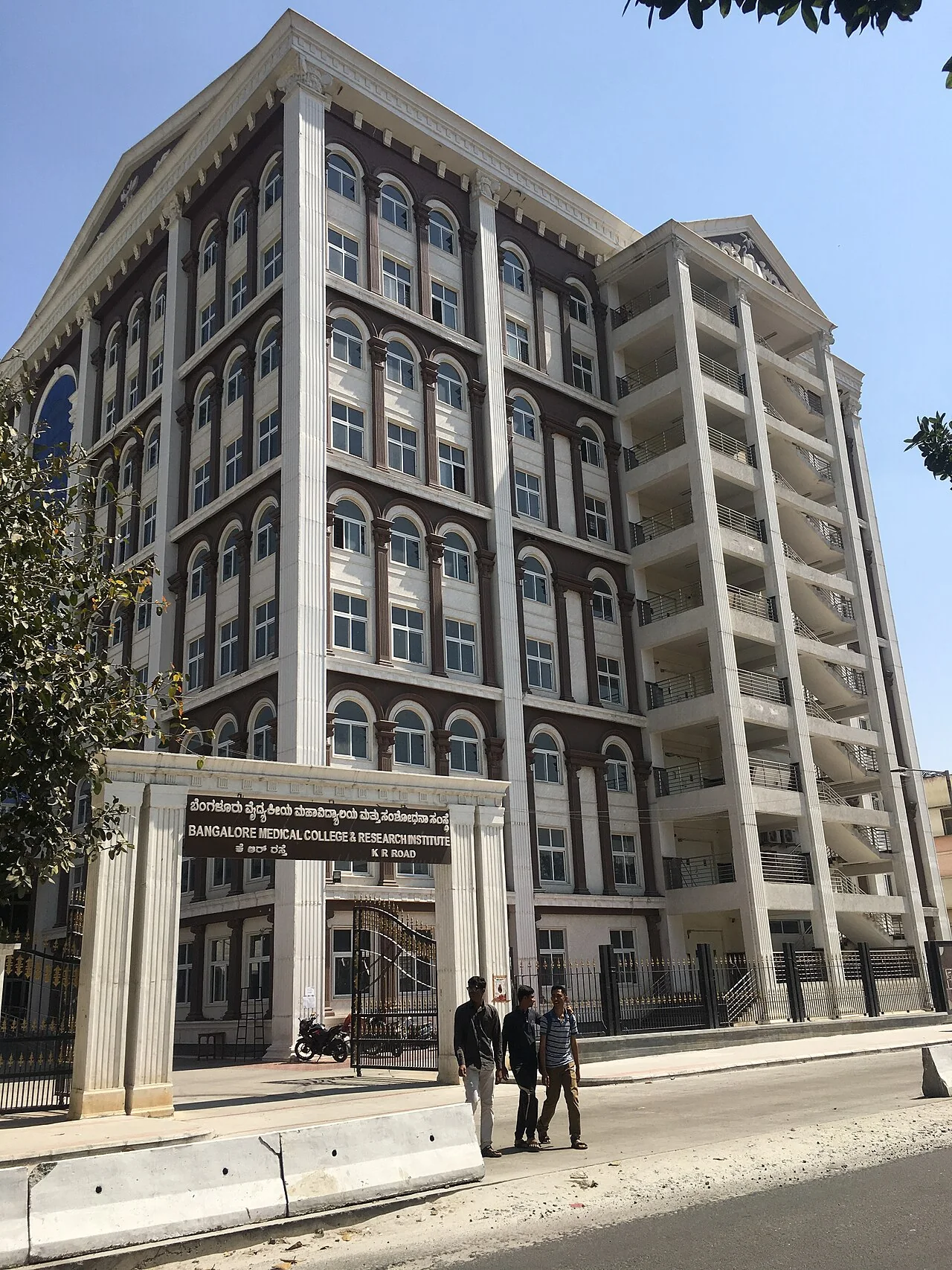
K. R. Road, Fort, Bengaluru
Each image retains its date and credit. Historical views may differ from the campus today.
 Photograph unavailable. Please try again later.
MEDICINE · BENGALURU · GOVERNMENT
Established in 1955, Bangalore Medical College and Research Institute combines medical education with a network of public teaching hospitals in central Bengaluru. Its campus on K. R. Road is linked with Victoria, Vani Vilas, Minto, PMSSY and trauma-care settings.
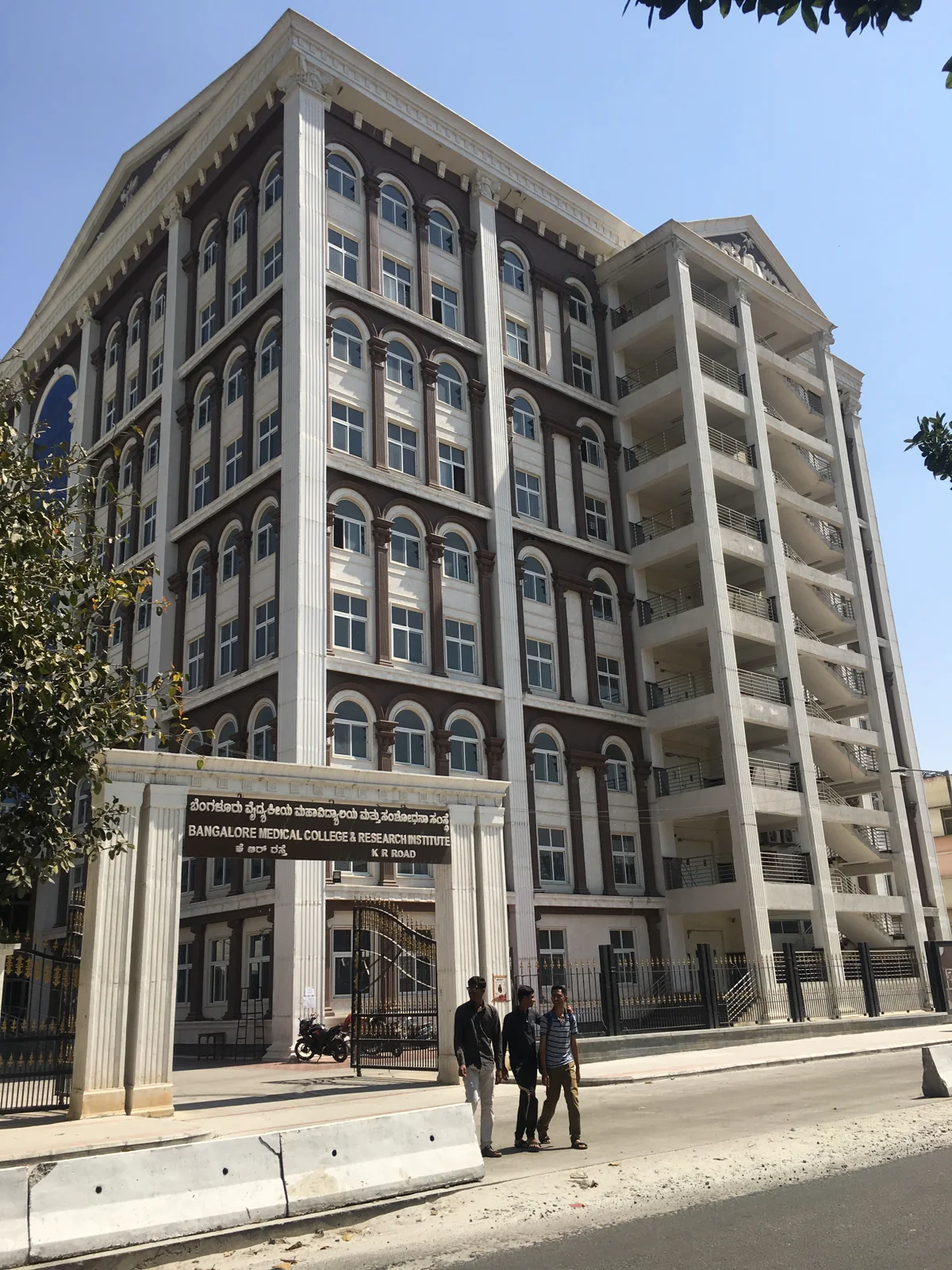
BMCRI began as a private medical school established by the Mysore Education Society in 1955. The government took over its management in 1957. Its institutional history records affiliation to Rajiv Gandhi University of Health Sciences from 1996. The names Bangalore and Bengaluru appear in different publications; this page concerns the same government institution on K. R. Road, not a separate private college.
The college is based in the Fort area of Bengaluru. Its academic setting extends beyond a single teaching block: the attached public hospitals provide distinct settings for general medicine and surgery, women’s and children’s health, ophthalmology, specialist care and emergency care. Classroom study, laboratory practical work and supervised hospital postings form different parts of medical training.
For a student, this means that college reporting, academic attendance and clinical postings may involve different locations. The college’s admission manual identifies the reporting venue, while the teaching timetable determines the hospital unit used by a batch. The presence of several hospitals should not be read as a promise of a particular individual procedure count or an unsupervised clinical role.
| College detail | BMCRI reference |
|---|---|
| Full identity | Bangalore Medical College and Research Institute, Bengaluru |
| Institution code | KA/005/G/1 |
| University affiliation | Rajiv Gandhi University of Health Sciences |
| MBBS annual intake | 250 · AY 2026–27 · NMC 18 September 2026 |
| Postgraduate and super-speciality scope | 31 named qualifications · NMC 29 September 2026 |
| Academic duration | MBBS: 4½ academic years plus one-year compulsory rotating internship |
UNDERGRADUATE
250 annual places in the dated 2026–27 NMC table. The programme combines foundational sciences, clinical study and the compulsory rotating internship.
POSTGRADUATE
19 individually named MD qualifications and five MS qualifications. Entry follows the relevant NEET PG and counselling requirements.
SUPER-SPECIALITY
Three DM and four M.Ch qualifications appear in the reviewed NMC table. Applicants need the course-specific eligible feeder qualification and relevant NEET SS route.
The course catalogue contains 32 named medical qualifications. This is a count of degree-and-specialty entries, not the total number of seats. The 24-entry MD/MS group and seven-entry DM/M.Ch group are subsets of that catalogue.
Medical and surgical subjects are shown individually on the Courses page with their duration, entry qualification, examination/counselling route and dated intake. The undergraduate intake table is dated 18 September 2026; the postgraduate and super-speciality table is dated 29 September 2026. Both refer to AY 2026–27.
| Qualification | Named entries | Admission examination |
|---|---|---|
| MBBS | 1 | NEET UG |
| MD | 19 | NEET PG |
| MS | 5 | NEET PG |
| DM | 3 | NEET SS |
| M.Ch | 4 | NEET SS |
BMCRI’s identity is closely linked with its attached public hospitals. The institutional profile names Victoria, Vani Vilas, Minto, the PMSSY super-speciality hospital and the Trauma and Emergency Care Centre. These settings serve different clinical purposes and should not be presented as interchangeable campuses.
The medical course links scientific foundations with patient assessment, case discussion and supervised clinical learning. Undergraduate postings and the rotating internship are separate stages. Postgraduate and super-speciality training is tied to a named degree, specialty and eligible training unit.
General hospital teaching
The institutional profile identifies Victoria as part of the attached public-hospital network. Clinical postings depend on the course and unit timetable.
Women’s and children’s healthcare
This setting is relevant to obstetric, gynaecological and paediatric learning within the supervised programme.
Eye-care setting
The ophthalmic hospital provides a distinct clinical context for eye-care teaching and the related specialty.
Advanced specialist care
The named hospital is part of the institution’s specialist-care setting; course-specific exposure follows the relevant teaching unit.
Emergency and trauma setting
The centre adds an emergency-care setting to the network. Student responsibilities remain governed by training stage and supervision.
STEP 01
MBBS applicants use NEET UG. Applicable Karnataka state seats go through KEA; applicable All India quota seats go through MCC.
STEP 02
The allotment identifies the institution, qualification, quota and reporting window. Registration in counselling is different from completing admission at BMCRI.
STEP 03
The 2026–27 manual requires the candidate to report in person. The process cannot be completed only online or through a representative.
The manual identifies the new college block on K. R. Road, opposite Kote Sri Venkateshwara Swamy Temple and Fort High School, as the reporting venue. Document verification precedes authorised payment and issue of the admission letter. All India and state-quota entrants have different document requirements, so the applicable checklist follows the allotted route.
For MD/MS, the qualifying medical degree, internship and registration requirements accompany the relevant NEET PG route. DM/M.Ch admission follows the eligible feeder qualification and NEET SS process.
Read the BMCRI admission section →The retained BMCRI 2026–27 manual gives a general-category first-year academic total of ₹75,300. It is a joining-stage total with several components, not a statement that ₹75,300 is recurring annual tuition throughout the course. The tuition component is ₹55,000; university-related and other college charges are shown separately below.
| First-year general-category component | Amount | Scope |
|---|---|---|
| Tuition | ₹55,000 | Tuition component of the retained first-year schedule |
| University-related charges | ₹9,350 | Included in the stated first-year academic total |
| Other college charges | ₹10,950 | Includes the caution-deposit component listed in the manual |
| First-year academic total | ₹75,300 | ₹55,000 + ₹9,350 + ₹10,950; general-category schedule |
The same manual distinguishes certain state-quota SC/ST/Category-I payments from the general-category figure. The conditional ₹11,300 figure is not a universal fee for every reserved-category or All India quota entrant. All India quota students are described as paying the full ₹75,300 at admission, with eligible reimbursement handled through the respective state.
A separate KEA allotment-result row records ₹64,350 as a course-fee field. Its payment period is not established by that result row. It must not be described as annual tuition or added automatically to the college’s ₹75,300 joining total, because the payments may overlap. A full-course total is not calculated from these unlike amounts.
See programme and quota fee details →The hostel schedule retained with the admission material separates yearly room rent from one-time mess and caution deposits. The university/college academic bill and the hostel bill describe different services. A college seat does not itself establish a hostel-room allotment.
| Undergraduate hostel component | Payable amount | Refund or payment basis |
|---|---|---|
| Room rent | ₹16,500 | Per year; not shown refundable |
| Mess deposit | ₹15,000 | One-time; ₹7,500 shown refundable |
| Caution deposit | ₹15,000 | One-time; ₹7,500 shown refundable |
| Admission fee | ₹500 | One-time |
| Water and electricity | Consumption-based | Monthly billing; no fixed amount asserted |
The first four payable components add to ₹47,000 if all apply to the allotted undergraduate hostel place. This is a transparent calculation from that schedule, not an all-inclusive annual living-cost estimate. Ongoing mess charges, consumption-based utilities and personal expenditure are additional; refundable portions retain their own conditions.
BMCRI’s central Bengaluru location and hospital network make the daily journey relevant to accommodation choices. The college block, assigned hospital unit and accommodation are different destinations. This overview does not publish a fixed commuting time, a guaranteed room, an internet speed or a hostel capacity without supporting evidence.
The installed BMCRI cutoff section separates MCC 2026 All India quota observations from selected historical KEA 2024 state-counselling cells. MCC rows below use NEET All India Rank and the allotted Open category. They are observed allocation endpoints from the retained extract, rather than a predicted future closing rank.
| MCC 2026 · All India quota · allotted Open category | Lowest observed NEET AIR | Highest observed NEET AIR |
|---|---|---|
| Round 1 | 109 | 1,774 |
| Round 2 | 1,076 | 2,716 |
| Round 3 | 474 | 1,894 |
A larger AIR number is a different rank position, not a higher examination mark. Category headings refer to the allotment category used in the result, which must not be silently replaced by the candidate’s category. Karnataka reservation categories and KEA table headings remain separate from this MCC extract.
The source year, round, course, quota and rank scale travel with each figure. The detailed Cutoffs page retains the other allotted-category observations and separately labelled KEA cells.
Read all category and round tables →Explore in four steps
Browse 32 named qualifications, with duration, route and dated intake.
Explore courses →Read the ₹75,300 academic joining schedule separately from hostel costs.
See fee details →Keep MCC All India Rank observations separate from KEA category tables.
Explore cutoffs →Follow the BMCRI in-person reporting and document-verification process.
Admission steps →Academic data in context
4.5 academic years · 81.8% of published duration
1 internship year · 18.2% of published duration
Duration composition. This is not a student, seat or placement chart.
| MBBS phase | Duration | Share of the 5.5-year programme |
|---|---|---|
| Academic study | 4.5 years | 81.8% |
| Compulsory rotating internship | 1 year | 18.2% |
The institutional profile describes classrooms, teaching laboratories, museums, skills facilities, a library and auditoriums, alongside the hospital network. These are learning resources rather than separately invented academic programmes.
Laboratory and museum work supports the scientific and specimen-based parts of medical study. The retained 2026–27 fee material includes a simulation-skills-laboratory component. Practical training is part of an organised course: access, teaching sessions and assessments follow the college’s academic arrangements.
Library resources support reading around lectures, case discussions and postgraduate specialty work. The Facilities section brings together the dated institutional material without importing facilities belonging to another Bengaluru college.
FOUNDATIONAL SCIENCES
Academic practical work is distinct from patient-care duties in a clinical posting.
SKILLS
Simulation and skills teaching support procedural preparation within the programme.
STUDY RESOURCES
The institutional profile identifies the library, classrooms and auditoriums as part of the learning setting.
BMCRI’s college address is K. R. Road, Fort, Bengaluru 560002, Karnataka. Its 2026–27 reporting manual identifies the new college block opposite Kote Sri Venkateshwara Swamy Temple and Fort High School. Hospital postings use the relevant assigned clinical location, not necessarily the admission-reporting desk.
Practical quick answers
Yes. The institutional history records founding by the Mysore Education Society in 1955 and government takeover in 1957. RGUHS affiliation is recorded from 1996.
The NMC undergraduate table dated 18 September 2026 lists 250 annual MBBS places for AY 2026–27. This is intake, not a current counselling-vacancy count.
It contains 32 individual qualification-and-specialty entries: one MBBS, 19 MD, five MS, three DM and four M.Ch. Every entry has its own dated intake; 32 is not a seat total.
The institutional profile names Victoria Hospital, Vani Vilas Women and Children’s Hospital, Minto Ophthalmic Hospital, the PMSSY super-speciality hospital and the Trauma and Emergency Care Centre.
BMCRI is a government college. Applicable Karnataka state seats use KEA and applicable All India quota seats use MCC. Applicants register for the route that covers their eligibility and allotted quota.
No. The retained first-year general-category academic schedule has ₹55,000 tuition, ₹9,350 university-related charges and ₹10,950 other college charges, totalling ₹75,300.
Not automatically. The KEA result field and college joining bill may overlap. Their payment scope and the applicable quota instructions determine reconciliation.
It adds ₹16,500 room rent, ₹15,000 mess deposit, ₹15,000 caution deposit and a ₹500 admission fee, if all apply. Utilities and ongoing mess costs are not included; the two deposits each show ₹7,500 refundable.
The retained 2026–27 admission manual requires the candidate’s personal presence. Verification, authorised payment and collection of the admission letter are separate joining steps.
No. Internship, postgraduate training and later employment are different pathways. No verified college-wide salary or placement series is supplied by the material used here.
The MCC 2026 observations use NEET All India Rank. The separately labelled KEA tables have their own headings and category scope; neither should be presented as an invented marks conversion.
The MedCollege form requests guidance. It does not replace examination registration, counselling choices, a college application requirement or institutional admission reporting.
MEDCOLLEGE GUIDANCE
Tell us your qualification, counselling quota or fee question.
Design updated 26 October 2026. Institutional descriptions retain their earlier review scope; the academic intake tables and fee schedules keep their stated year. Counselling extracts are inherited from the installed profile. Intake is not a live vacancy count and an enquiry does not reserve a seat.
0 colleges selectedAdd up to four colleges to compare