Course overview
What is DOT?
An allied-health programme combining health-science foundations, role-specific technical skills, patient safety, communication and supervised clinical or practical training.
Best suited for: Students interested in supervised eye-care support, visual testing, refraction assistance, diagnostic equipment, optical services, community screening and patient communication.
QualificationDOT
LevelDiploma
Standard duration2 years
Primary entry routeState, institution or authority-specific process
Content reviewed 19 August 2026 by MedCollege Editorial Desk · Admission rules and seat data must still be checked for the current cycle.
Before you choose ophthalmic-assistant training
Understanding the DOT and proposed DOA pathway
What is DOT?
Diploma in Ophthalmic Technology is a commonly used search title for diploma programmes that prepare assistants for supervised eye-care services. Institutions may use names such as Diploma in Ophthalmic Assistant, Diploma in Ophthalmic Assistance or Diploma in Ophthalmic Technology.
The NCAHP draft uploaded on 5 June 2026 uses the title Diploma in Ophthalmic Assistant (DOA). It was released for public consultation and remains listed in the Commission's draft-curriculum directory rather than the approved-curriculum directory. Its eligibility, duration, internship, professional title and scope should therefore be treated as proposed standards until a final curriculum or adoption notice is issued.
Who should consider this course?
Ophthalmic assistants support ophthalmologists and eye-care teams with patient preparation, basic testing, documentation, equipment, community screening and clinical workflow. The diploma does not make a graduate an ophthalmologist or create independent medical-practitioner status.
At a glance
DOT course highlights
Use this summary to understand the qualification quickly, then open the detailed sections before making an admission decision.
- Qualification
- DOT
- Course level
- Diploma
- Standard duration
- 2 years
- Primary admission route
- State, institution or authority-specific process
Course decision
Why choose DOT?
01Vision and ocular science
Ocular anatomy, physiology, optics, visual science and common eye-condition foundations.
02Clinical testing support
Visual acuity, preliminary history, refraction support, tonometry, perimetry, keratometry and image capture.
03Equipment and theatre workflow
Instrument preparation, calibration, infection prevention, optical dispensing and supervised operation-theatre support.
04Community eye care
Screening, outreach, low-vision support, rehabilitation, health education, records and urgent referral.
Choose the course—not only the titleCompare the curriculum, training environment, recognition, admission route, total cost and long-term professional requirements before applying.
Entry requirements
DOT eligibility
Eligibility can change by admission year and candidate category. Treat the current official examination and counselling documents as controlling.
| Eligibility check | What the applicant should confirm |
|---|
| Qualifying education | Under the 2026 draft eligibility criteria, applicants would need to pass 10+2 or equivalent with Physics, Chemistry and Biology or Mathematics and obtain at least 50% marks. The draft proposes admission based on 10+2 merit. |
|---|
| Admission-year conditions | It also proposes a minimum age of 17 years, completed at admission or on or before 31 December of the admission year, and a mandatory medical-fitness certificate endorsed by a government medical officer. Reservation would follow central or state rules. |
|---|
| Documents and verification | These provisions are not final. Candidates must use the current prospectus issued by the state, university or institution and verify whether Biology, Mathematics, English, marks or age rules differ for the approved programme. Existing state or university programmes may use different entry levels and nomenclature. |
|---|
Stored course eligibility summaryThe qualifying examination, science subjects, age, marks and selection rules vary by programme and authority. Verify the current regulator, state, university and institution notice.
Academic scope
Duration, syllabus and learning areas
The exact syllabus, rotations and assessment follow the current regulator, university and institution curriculum. These are the major areas applicants should expect to investigate.
| Training phase | Major focus |
|---|
| Programme structure | The draft programme structure contains two years of academic study followed by a six-month compulsory supervised internship or clinical-training period. This proposed structure should not be presented as a final national duration until an implementation notice is issued. |
|---|
| Academic and practical progression | The draft internship schedule includes exposure to ophthalmology outpatient services, advanced refraction, diagnostic ophthalmology, operation-theatre workflow, optical dispensing, community eye care, outreach, low vision and rehabilitation. Actual postings and hours must be confirmed from the final or locally adopted curriculum. |
|---|
| Internship and completion | Existing programmes may follow a two-year, three-year or another authority-specific structure. Students should compare the approved academic calendar, practical hours, logbook, patient exposure, assessment and internship rather than relying only on the course name. |
|---|
Major curriculum areas
01Vision and ocular science
Ocular anatomy, physiology, optics, visual science and common eye-condition foundations.
02Clinical testing support
Visual acuity, preliminary history, refraction support, tonometry, perimetry, keratometry and image capture.
03Equipment and theatre workflow
Instrument preparation, calibration, infection prevention, optical dispensing and supervised operation-theatre support.
04Community eye care
Screening, outreach, low-vision support, rehabilitation, health education, records and urgent referral.
How training is commonly delivered
- Basic health sciences, ocular anatomy, optics and visual-science foundations
- Supervised visual-acuity, refraction-support and ophthalmic diagnostic practice
- Safe instrument use, maintenance, infection prevention and documentation
- Eye outpatient, operation-theatre, optical, community, low-vision and rehabilitation exposure
- Clinical logbook, skills assessment and supervised internship under the adopted curriculum
Skills the programme is designed to develop
Visual-acuity measurementPatient history supportRefraction assistanceOphthalmic equipmentInfection preventionEye-care documentationRed-flag recognitionUrgent escalation
College-specific evidence
Fees, seats and admission details
Fees and seats belong to a college, academic year, category and source. A blank seat value means MedCollege has not stored a sufficiently current verified intake—not that the programme has no seats.
| College | First-year planning fee | Published course total | Seats | Fee year/source |
|---|
| Netra Jyothi CollegeUdupi, Karnataka | Not published | Not published | Not published for 2026–27 | Not publicly listedOfficial source ↗ |
|---|
The first-year planning figure excludes a separately identified refundable caution deposit where the official fee schedule permits that calculation. A range means the amount varies by specialisation. The published total shown is the course fee in the cited notice; hostel, mess and personal expenses may be separate.
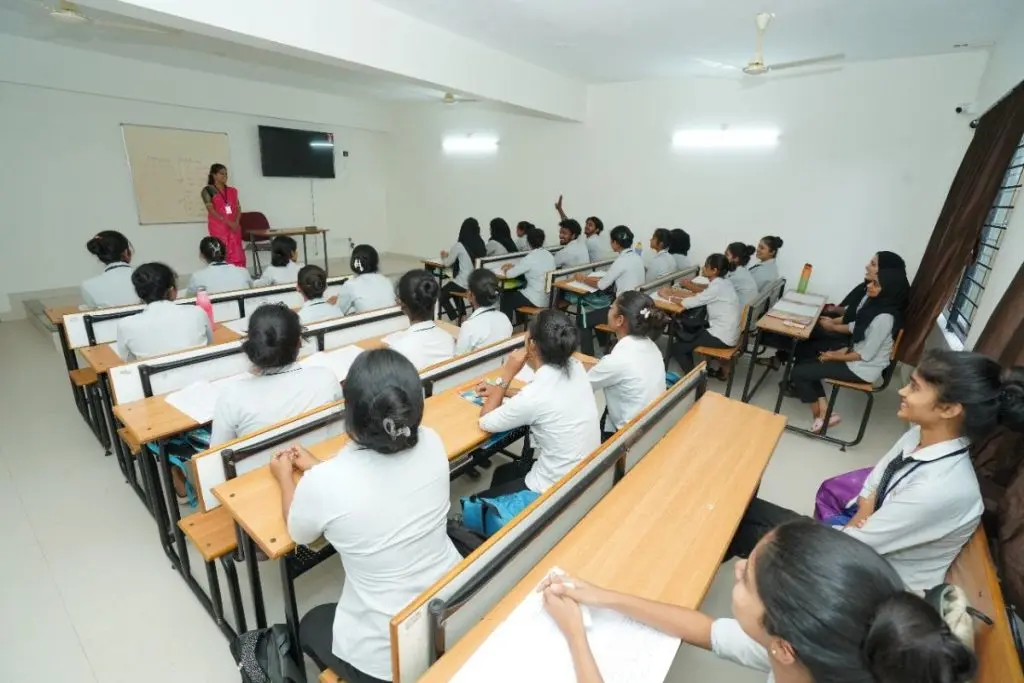
Netra Jyothi College admission note
Contact the institute for the current application form, submit the required academic and identity documents, complete programme-specific eligibility checks, and obtain a written offer. Before payment, request the current fee sheet, refund rules, intake and affiliation confirmation for the exact 2026-27 programme.
After the qualification
Career scope and further training
Role-specific clinical, technical, diagnostic, rehabilitation, research, academic, industry or health-service opportunities, depending on recognition, registration, competence and further qualifications.
✓Ophthalmic assistant, ophthalmic technician or employer-defined eye-care support roles
✓Eye hospitals, ophthalmology clinics, vision centres and community programmes
✓Optical, screening, low-vision or equipment-support environments after suitable training
✓Eligible optometry progression where the current university expressly accepts the diploma
Where graduates may work or train
↗Eye hospitals and ophthalmology departments
↗Vision centres and community eye-health programmes
↗Optical and refraction-support services
↗Ophthalmic equipment, screening and low-vision services
Higher study and professional development
Optometry progression
The current NCAHP Optometry curriculum permits conditional lateral entry from recognised related diplomas, but the university must approve the exact award and credits.
Do not assume equivalence
A diploma in ophthalmic assistance is not the same qualification as a B.Optom and does not create independent medical-practitioner status.
What affects salary and earnings?
MedCollege does not present one unsupported average salary as a guaranteed outcome. Pay varies substantially according to:
Role and level of responsibilityEmployer type and locationExperience and additional qualificationsWorking hours, incentives and employment conditionsQualification recognition, documented patient exposure and equipment competenceClinical supervision, shift work, outreach travel, safety systems and continuing education
Qualification is not the same as guaranteed employmentCareer outcomes depend on registration, competence, experience, location, employer requirements and any additional credential needed for the role.
Compare pathways
DOT course comparison
| Decision factor | Ophthalmic diploma | B.Optom |
|---|
| Current status | Authority-specific award; national DOA curriculum remains draft | Approved NCAHP undergraduate optometry framework |
|---|
| Training level | Assistant-level eye-care support within recognised competence | Broader professional optometry education |
|---|
| Duration | Verify local rules; draft proposes two years plus six-month internship | Five years including one-year internship under the cited curriculum |
|---|
| Progression | Conditional lateral entry only where expressly approved | Degree-level pathway subject to current registration framework |
|---|
This comparison explains academic pathways. It does not replace the current eligibility, recognition, entrance or registration rules for either qualification.